
I don’t need to tell you that we’ve been inundated with AI discourse. Whether it’s through social media feeds, podcasts, CEO proclamations, and now even commencement speeches, it’s all about humans versus AI. When does AI take over knowledge work and operate on a level better than what any human expert could accomplish?
I will talk about discernment of human work from machine work another time, so for the purposes of this article, I’m going to operate with the assumption that we’re dealing with the domain of intentionally chosen machine work.
Science fiction and marketing materials from tech giants that anthropomorphize algorithms tell us that machines see all, but they, too, have blind spots. Here’s what you need to watch out for when it comes to machine learning blind spots within pay-per-click advertising campaigns.
Machine Learning and a Ski Resort: A Slippery Slope
Picture this. Imagine there’s a ski resort running Google Ads, and they feel like they’re doing everything right according to textbook best practices. They’re running smart bidding. They’re leaning into automation. They’re using numerous headlines, descriptions and ad creatives. Their goal, at the end of the day, is to sell as many tickets as possible while generating maximum ROI, so they set their conversion goal as ticket sales. Google Ads understands the revenue coming in from the transaction events, and the system is doing exactly what it’s being told to do.
All the machine knows is to deliver ads to audiences and set bids for auctions based on what it thinks will convert while achieving the stated goal: a certain return on ad spend. However, there are two scenarios where this ideal and apparently straightforward situation can go very, very wrong.

Scenario 1: Itching for the Slopes
It’s early December. We’ve had the first big snowfall of the year. Skiers have been itching to get on the slopes. Even people who ski casually or those who are looking for something new to do may want to head to the ski resort because it’s the first snowfall of the year. It’s exciting!
In this scenario, there’s a lot of pent-up demand for skiing. The tickets will essentially sell themselves. You might think, what’s wrong with that? Your Google Ads campaigns have a major blind spot in this situation. Without human intervention, your ads will keep running, trying to solve a problem that you don’t currently have. You can only sell so many tickets, and the first snowfall does most of the selling for you, leaving your ad spend wasted after capacity has sold out.
What’s worse, the machine might use historical data about increases in search demand for skiing around late December or even user behavior data and anticipate a higher than normal opportunity for serving ads and converting users.
This could lead to bidding higher and overspending stated daily budget targets in an attempt to do a good job according to what it judges to be the goal of the campaign. But I’d like to propose a common sense principle to govern advertising budgets: spend as much as is necessary to obtain the optimal return, not as much as possible to get all marginal revenue.

Scenario 2: Does This Ski Resort Have a Pool?
Weather can change fast. Say that it’s the middle of the season, and it should be perfect skiing weather based on historical norms, but instead, it’s 75 degrees outside and sunny. Nobody will be skiing today, tomorrow, or likely even the next day, but if you don’t intercept the machine, the system will keep bidding.
The goal of any campaign is to keep delivering, keep spending dollars, and keep generating conversions, but its defaults lack the context that humans can see, leading to the machine playing a game it can never win.
Even though an argument could be made that “as long as there is search demand for skiing” we should meet and convert that demand, availability and capacity are the hard constraints and peak future periods may already be sold out. Oftentimes in scenarios like these, the efficiency drops dramatically and the marginal cost per conversion goes up, sometimes beyond your acceptable tolerance.

Context = The Missing Link
The problem is that there’s no way to tell the machine that it can cool it on pushing sales because demand is high, or that it’s basically summertime outside, because these aren’t inputs the machine receives under normal operating conditions. This can lead to you staring at your Google ads performance, wondering why the numbers look OK but the business doesn’t feel right. The context is a huge part of the game.
When Smart Bidding Isn’t So Smart
Obviously, I’m not just talking about ski resorts. This example pertains to a category of mistakes I’m seeing routinely in all sorts of advertising accounts and niches. It’s easy to lean into automation without thinking about the context that machine learning can’t see.
Frederick Vallaeys, Founder of Optmyzr and former Google employee, talked about this in his 2019 book Digital Marketing in an AI World:
“However, the system may very well not be considering one or more factors that are critical to your particular business, such as specific budgetary constraints or current trends in your industry.”
Digital Marketing in an AI World, pp. 68–69
And again:
“The system hasn’t yet seen examples of new types of data that may be especially relevant to the case at hand. It’s not good either at encountering or coming up with something entirely new.”
Digital Marketing in an AI World, p. 74
Blind spots can happen in a variety of ways: measurement and goal configuration, smart bidding strategy selection or target configuration, broad match keyword query matching, or unconstrained ad testing combinations. Often it’s based on missing, flawed or incomplete data like offline conversions or post-conversion outcomes for lead generation advertisers. Other times it’s a modeling problem, with the economic constraints and competitive realities of the business not being fully accounted for.
Whatever specific choices you’ve made in setting up and configuring your Google Ads account, chances are that you’re relying on these specialized machine learning algorithms for at least one aspect of getting your ads in front of people with the goal of getting them to buy your stuff.
Often, when operating within their narrow domain of focus with full context and sufficient volume and quality of data, they do exceedingly well. But when they operate with blindspots, the results can be catastrophic.
Don’t Debate About Humans vs. AI. Ask This Question Instead.
While it can be useful to think about where technology can assist you in producing a better result or adding a benefit like time savings, it’s helpful to get more specific when evaluating features of the Google Ads and other PPC platforms.
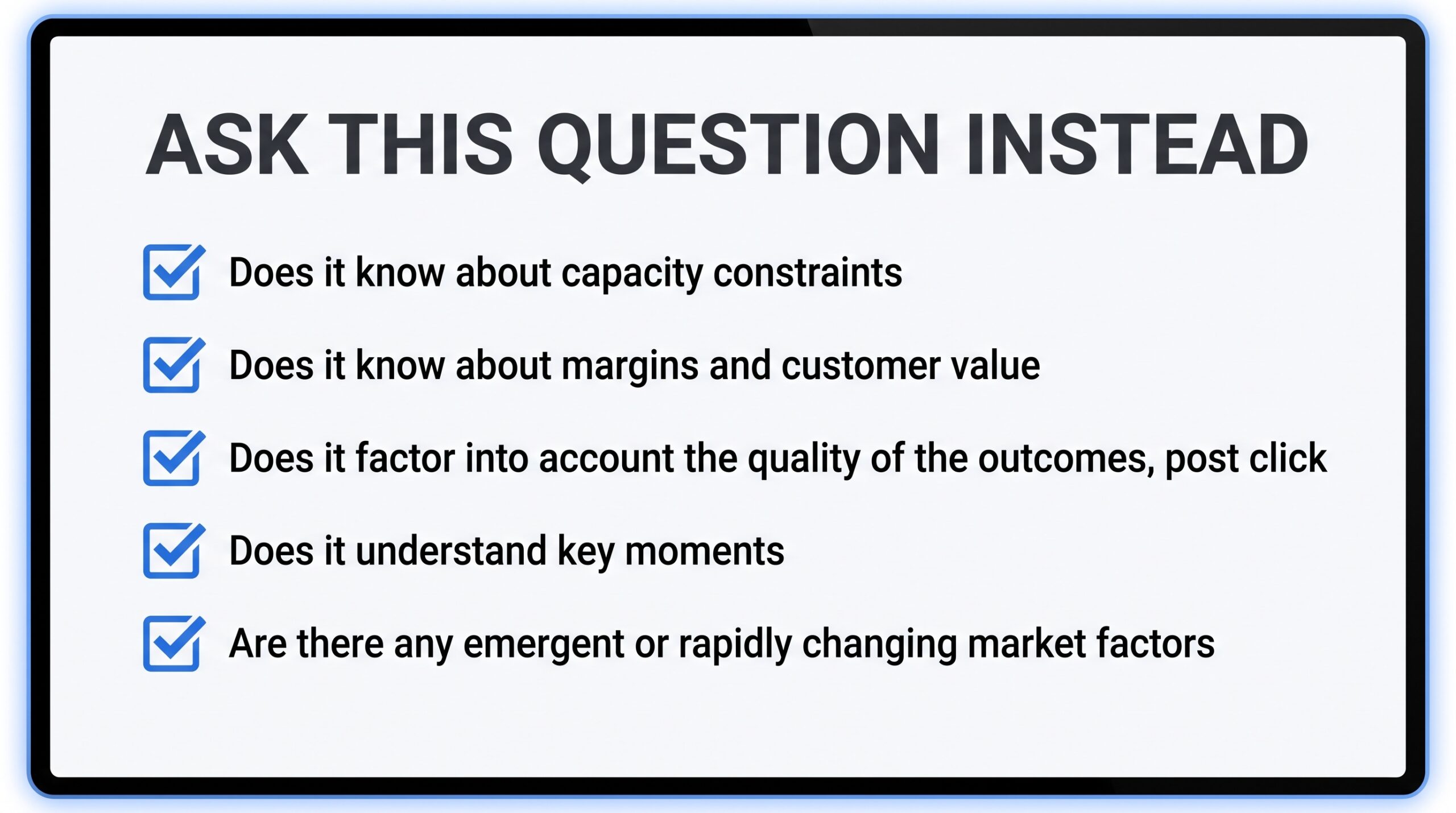
Ask yourself: Does this smart bidding (or any other machine learning or AI) algorithm have all of the context that it needs to make a good decision?
- Does it know about capacity constraints
- Does it know about margins and customer value
- Does it factor into account the quality of the outcomes, post click
- Does it understand key moments
- Are there any emergent or rapidly changing market factors
Smart bidding and machine learning algorithms are great at looking at topical data, unearthing quantitative patterns in large data sets, and extrapolating them to make predictions about what’s likely to happen in the future. However, if that data is materially incomplete, or you can’t send back meaningful signals for it to compare its predictions, the machine will fall totally flat.
You have to realize that your data set is incomplete, because you’re not going to receive a warning from your dashboard that something is missing.
The Silent Killer in Ad Accounts
I would even go as far as to say that this problem is a silent killer in accounts. The thing is, you have to realize that your data set is incomplete, because you’re not going to receive a warning from your dashboard that something is missing. The more you rely on these automated processes, the more you compound your risk. Instead of blindly following what these machines are telling you, you have to go in with discernment.
This is even more true as the functionality of things that 99% of advertisers rely upon, such as smart bidding strategies with a target return on ad spend (tROAS) or target cost per acquisition (tCPA) continues to shift.
Don’t Rely on an Algorithm to Play a Game It Can’t Win
If an algorithm lacks the proper context, it can spawn a lot of waste in the process of trying to get to the right answer. Instead of doing that, your best move may be opting out of “smart” strategies. Before I’ve completely convinced you, let’s look at a B2B e-Commerce distribution company to see where opting for too much automation can go wrong.
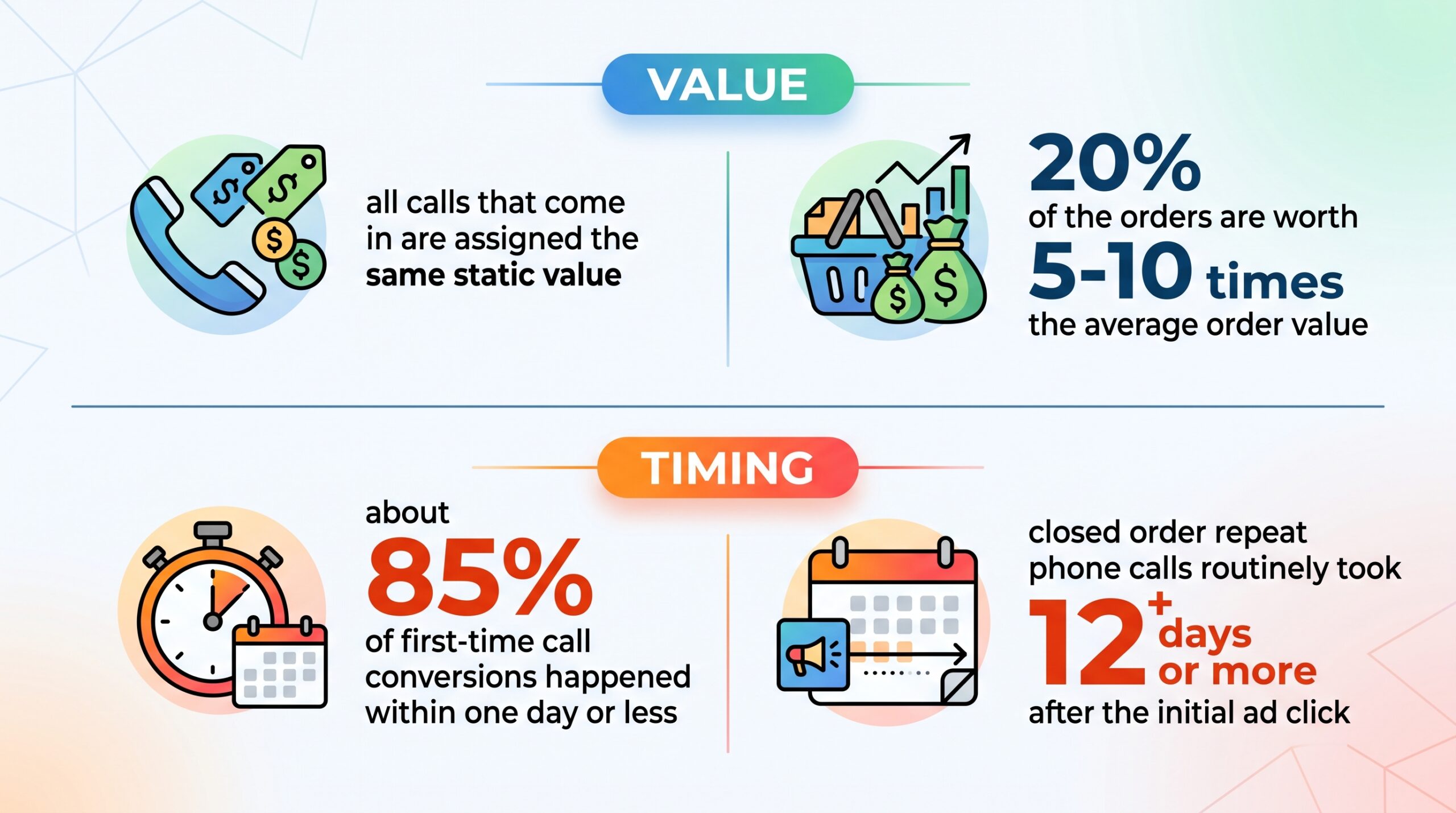
When I audited this account, I saw that call tracking and e-Commerce transactions were enabled, which is great. There are a handful of campaigns, a lot of broad match keywords, and there is a reasonable number of conversions happening each month. The account has smart bidding running, with some campaigns opting to maximize conversions, and others aiming for a target cost per action. However, all calls that come in are assigned the same static value.
After talking to the client and digging in further with their back-end sales data, we realize that there’s a huge 80/20 effect happening. The highest value orders and customers were coming through offline conversion channels, like phone calls, but they were being valued the same as other conversions that drove lower-value sales. The lack of actual revenue attribution to the closed call orders created a significant blind spot.
Knowing this, you might start to rethink the bid strategy selection. Maybe in a world where 20% of the orders are worth 5-10 times the average order value, it’s not as appropriate to use cost per conversion bidding. Instead, it might be better to look at Target Return on Ad Spend (ROAS) bidding. The valuation is obscured by the large order, but the average order is actually much lower.
Rethinking the Game Based on the 80/20 Rule and Real-Life Context
What’s more, there was often a significant lag between that initial phone call and the subsequent calls that resulted in a closed order. I found that while about 85% of first-time call conversions happened within one day or less, the closed order repeat phone calls routinely took 12 days or more after the initial ad click.
Additionally, the value of calls and the likelihood of that initial contact to eventually turn into a closed deal our client cared about varied greatly by campaign. When this all became apparent by examining call logs, we knew we needed to differentiate between conversion actions, assign values based on an adjusted expected or actual value, and change goal conversion assignment at the campaign level to achieve far better results and allow our smart bidding strategies to work for us more reliably and effectively.
This conversion value and bidding issue is just one example of a blind spot we found in this account. There were more, and we see them in almost every account. For example, product availability with specific items, especially stock levels and lead times. Another can be margins and MAP pricing enforcement. If you’re only reporting and looking at ROAS, it may feel like you’re winning, but you may actually have worse net profit.
That’s why we’ve made it a practice to routinely audit lead quality, conversion goals, pipeline outcomes, and goal values to ensure we are calibrating our measurement and attribution to achieve real business success.

Example: Performance on “Industrial Valves”
Let’s pretend that in your niche, a general keyword you’d bid for is “industrial valves.” Insert with whatever “Widget X” you have in your business. At any rate, the term is a little ambiguous, and maybe the intent for the keyword is equally unclear. A handful of products might fit the bill, and you may have 3 candidate SKUs that could be appropriate for this keyword.
So let’s suppose that in your PMAX campaign with a feed, maybe one SKU starts leading the pack, winning in terms of click-through rate, ROAS, or conversion rate. From there, you get a snowball effect, where smart bidding will start optimizing more delivery to this SKU, cannibalizing delivery on the other two products.
But maybe it turns out that the third SKU, the one not getting much attention, has a 60% margin, while the winning SKU only has a 20% margin. If the product price or average quantity ordered result in similar levels of revenue per order, your reported ROAS may be similar, while your net profit per order is wildly different. We’ve seen instances where the “third SKU” is also a unique product for our client with higher conversion rate potential and the algorithm by default pushes another SKU that overlaps with what other advertisers are showing in the buy box.
I hope this example shows you that it’s not just as simple as automating a process and letting it go. You need to consider all of the possible blind spots in terms of data, audience, behavioral information, willingness to buy, and all other possible scenarios that might make an optimization appropriate or inappropriate.

Your Campaigns Need The Checklist Manifesto
Quite frankly, for your processes to be successful, you’ll need a Checklist Manifesto-level exercise. Considering all possible variables outside of what your machine can see can help you avoid a system that’s confidently bidding into conditions that no longer exist, or into an incomplete model of reality. No matter how fine-tuned you think you are, there’s always the possibility that new operating conditions or new realities will come into play. Any novel factors are blind spots for your systems.
This is where humans will always shine. We are uniquely able to add judgement, steering and piloting systems to avoid falling prey to blind spots. It’s easy to fall into blind spot traps when we listen to the loudest voices in the space, especially as AI starts to dominate more of the conversation no matter which feed you read. It’s also alluring to go along with the narrative that it’s all being handled for you, and that somehow your job is going to be easier and better now when you let go of the controls.
While there are some narrow parts of these arguments that are true, and it is possible that AI will be able to run aspects of your campaigns in some ways that are better than humans, the hidden assumption that these machines can solve all contextual problems is where the illusion starts to crack. They simply do not possess all of the relevant information or capability, and there seems no credible evidence to believe that they will ever replace humans where it matters most. To believe otherwise is to fall prey to marketing and sensationalism.
If I could leave you with one takeaway after reading this article, it’s that there is always a place for human judgment and contextualizing. The job of anyone you’re paying to run your pay-per-click campaigns is to understand the information that machine learning algorithms possess, and determine which decisions need to be made by a human instead of a system.
Somebody working on your account always needs to think about how it’s 75 degrees outside. There’s no “set it and forget it” to PPC campaigns. The humans working on your accounts need to constantly evolve with your ever-changing reality. Adapt accordingly, use automation with discernment, and you won’t be caught off-guard with machine learning blind spots.
Not Sure What Your Algorithms Can’t See?
We audit conversion goals, goal values, audiences, lead quality, and pipeline outcomes so your smart bidding runs with the context it’s missing.