
Introduction, or Why Broad Match Spend Should Never Exceed the Percentage of “other” Search Terms
This is going to sound like a riddle, but stick with me: How can you combat unknown unknowns?
Controlled broad match keywords. If your Google Ads spend on broad match keywords exceeds the spend on “other” search terms in your report, you’re paying broad match prices for queries that are actually visible and that should be built out or negated.
This article will take you through how to achieve clarity, improve precision, and drive a better return on ad spend (ROAS) and cost per acquisition (CPA).
Taming the Unknown With Controlled Broad Match Keywords
If you’ve thought, as I did, that broad match keywords were a lazy way to target in the past, my goal is to get you to change your mind by the time you finish reading this.
“The Birth of Broad Match”
In the first edition of his book, Digital Marketing in an AI World, Frederick Vallaeys addresses “The Birth of Broad Match,” explaining how Google used this feature to help advertisers gain exposure to the 30% of queries that appeared for the first time in a 90-day period. Getting that exposure can help improve performance and boost conversions, because you can’t predict every possible query that you might rank for.
Many advertisers were either begrudgingly implementing broad match, or still ignoring this advice by opting instead to use DSA campaigns or simply mine out new keywords from phrase match search term reports to get coverage.
More recently, there were bolder moves by Google like the dilution of match types that made broad match keyword adoption more commonplace. This seems sensible when exact match isn’t exact anymore, and phrase and broad matching are much more liberal. With that, this topic has fallen away from mainstream pay-per-click (PPC) strategy discussions.

Revisiting the Keyword Match Type Conversation in a Changing PPC Landscape
Another reason why keyword match types as a focus have taken a back seat is because many accounts run a lot more traffic through campaign types other than search. This includes shopping, performance max (PMax) and now AI Max campaigns.
I believe keyword matching has also been ignored more from newer PPC managers coming up, assuming that if match types have all broken down, keyword targeting doesn’t serve a very important function any more.
But there are two cases that we are specifically guarding against with “controlled broad match”. First, in accounts already delivering a majority share of search spend through broad match keywords: if top-level performance looks fine, account managers may assume that their existing keyword targeting is comprehensive enough.
Second, in accounts using more strict match types and following the rigid account management practices that were mainstream in the 2010s: if you are driving pure efficiency but having difficulty to scale (also reflected in measures like the Lin-Rodnitzky ratio or the percentage of search spend as broad match) you are missing opportunities for topline revenue.
And so, in all likelihood, most accounts are not fully optimized, either over or under utilizing broad match keywords. The assumption that targeting is just fine as-is is broken by two simultaneous realities:
- A meaningful share of search queries are new to Google within any given 90-day period
- Google Ads suppresses a meaningful, and sometimes majority share of search terms from the search terms report entirely (“search terms: other”)
In other words, even if a query converts or is potentially relevant to be added with a phrase or exact match type, you may never know about it. It could be buried in the search terms, never to surface in your reports through the interface or the API. And with AI Max, it seems this problem is only worsening.
It is this exact suppression of search terms by Google and the narrative that “it’s too hard now, let AI do it” that is why a measured response is crucial to account health, and why the conversation around keyword targeting and match types deserves another look in its current configuration.
Definition
What is Controlled Broad Match in Keyword Targeting?
When I talk about taking a controlled broad match approach in keyword targeting, I’m referring to a broad match keyword that operates in its own campaign and its own ad group, controlling for necessary variables while increasing exposure to relevant queries. I’ll talk more about the specific approach later on, but the goal is to increase the surface area of your targeting by finding new queries you didn’t previously predict, and by increasing exposure to queries that may never show up in search term reports.
Controlled Broad Match Keywords as a Liquidity Tool
In light of these realities, it’s important to think about controlled broad match differently. It’s not a targeting shortcut or a “lazy” approach. It’s a liquidity tool that surfaces demand the account can’t otherwise see. Think of it this way: You can either bid more on the same existing keywords and get more impressions on them, or you can get more impressions on a greater variety of search queries and learn more about what works and what doesn’t.
In some cases, you might use broad search and you match to queries that surprise you. Maybe you didn’t predict them or didn’t know about them, and some of them work! They show up in search terms and you can build them into targeted keywords, optimizing more for better landing page and ad copy fits.
In other cases, you may gain ground for queries that are potentially a fit, but you’ll never see them reported. Even if you dig into the tooltip in the interface that Google talks about, it may not disclose search terms to you. In these cases, unfortunately, you’ve got to just take the win, and maybe use post-click data to validate outcomes if it’s available to you at that level of granularity.
So, how do you address the unknown unknowns in a smart way and receive a better cost per conversion? Controlled broad match keywords.
It’s not a targeting shortcut or a “lazy” approach. It’s a liquidity tool that surfaces demand the account can’t otherwise see.
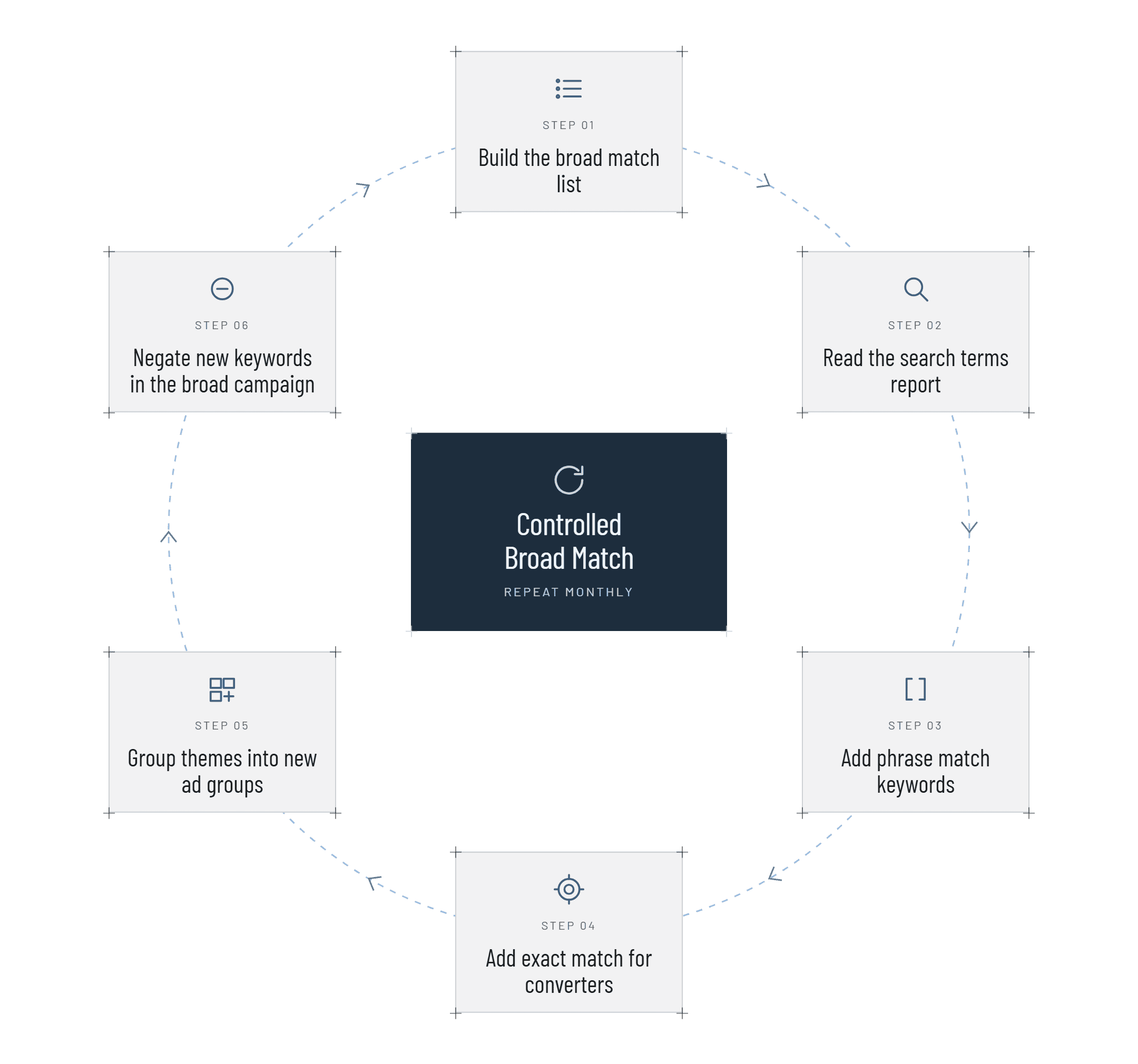
Your Optimization Routine with Controlled Broad Match Efforts
Here’s the routine you want to start:
- Begin by building out a list of broad match keywords.
- Look at search queries that match to them in the search terms report.
- Add relevant queries as targeted phrase match keywords in existing ad groups outside of your broad match campaign.
- Add exact match versions of the keywords, especially for anything that has converted.
- Build out any query that has significant enough volume to matter and justify ongoing management.
- If there’s a thematic match among several queries, you can create a new ad group, then create an ad with greater relevance since you now know what is getting searched with greater precision.
- Add any newly targeted keywords as negatives in your primary broad match campaign to keep it focused on discovery.
This routine leads to greater ad relevance, a better quality score, and a more competitive edge for bidding, improving your CPA and ROAS.
So, How Do You Know You Need a Controlled Broad Match Approach?
What are the signs that your broad match keywords aren’t generating what they should? You might be a good match for a new approach if you see yourself in one of these scenarios:
- You Have a Mature Account that Needs More Volume: You’re largely hitting your non-branded search campaign goals. You hit efficiency targets. You might be maxed out on bidding or budget and you feel like you’re targeting everything you know about. You have a managed, mature account but you’re looking for more volume and more conversions. This might be the next step for you.
- You Have a High “Other” Percentage in the Search Terms Report: Your search terms are significantly converting, but they’re in the “other” bucket. Or, maybe, you’re seeing impressions and clicks pooling in the “other” category.
- You’re Treating PMax as a Sponge: Maybe you’re not building broad match because you feel like maximizing on performance will inherently deliver on more head term keywords (1-2 word keywords). But with this approach, you lack the level of control to steer it with enough precision, leading to wasted ad spend.
- You Have Too Much Spend in Broad Match Today: Perhaps you are already delivering 50% or more of your search ad spend through broad match keywords, which you can quickly check in the interface using a “match type” filter set to “broad” and comparing filtered spend to total spend.

Example: The Telltale Signs You See When You Zoom In
Let’s put it into an example that convinced me that controlled broad match keywords are basically an operational necessity. In a six-figure monthly ad spend Google Ads account, this business had all of their “Old Faithful” queries (the ones that represent the 80/20 of conversion volume historically) present as targeted keywords. They had great coverage of product category and product type terms built through long-tail exact and phrase match keywords.
As we started to dig into the search terms, we found competitor terms, head terms and the very same “old faithful” keywords that were targeted elsewhere appearing in the reports. They hadn’t been set up as exclusions through negative keywords.
From a structural perspective, broad match keywords were commingled with phrase and exact match within ad groups, which is a common find. However, all of the ad spend was flowing to broad match instead of the more precise match type keywords. This cannibalization of ad spend was causing efficiency bleed at scale.
These are the kind of things you only see when you zoom in. From the top level, you may see conversions at a healthy CPA or within target, so things are good. Keep rolling, pour on more spend, move to testing other things, right? Wrong. Slow down!
Two “Dead Ringers”: Impressions and Conversion Volume in “Other”
To find these problems, you need to dig a little deeper. You have massive opportunities to drive your own CPA down because the average lies. It’s hiding inefficiencies, ad spend cannibalization, and these missed opportunities.
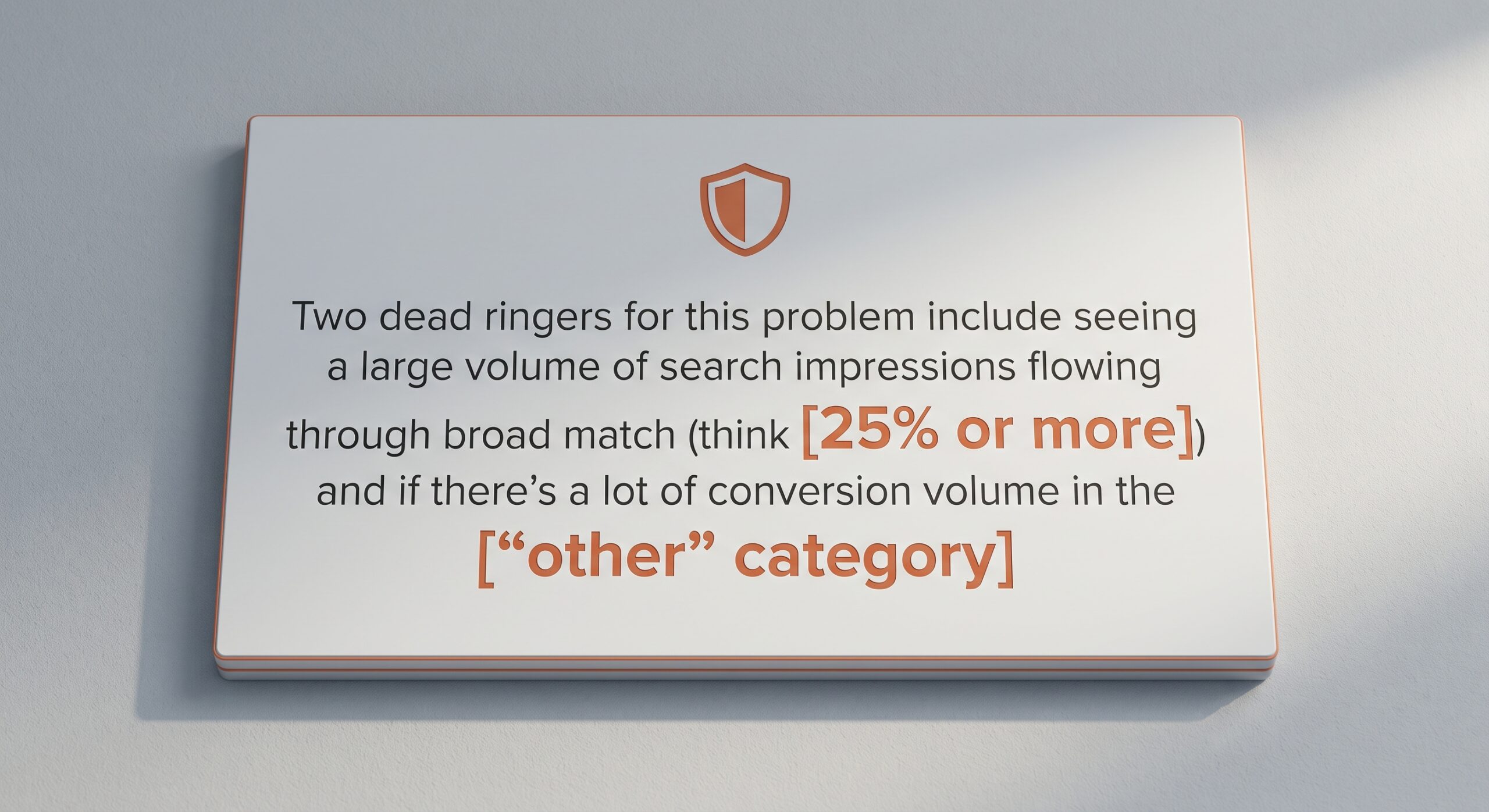
Again, two dead ringers for this problem include seeing a large volume of search impressions flowing through broad match (think 25% or more) and if there’s a lot of conversion volume in the “other” category of the search terms report. These tell us that not enough work is being done to build out what could be knowable, adding more precise keywords and negating irrelevant ones. These signs can tell us that adding a controlled broad match effort is the right move.
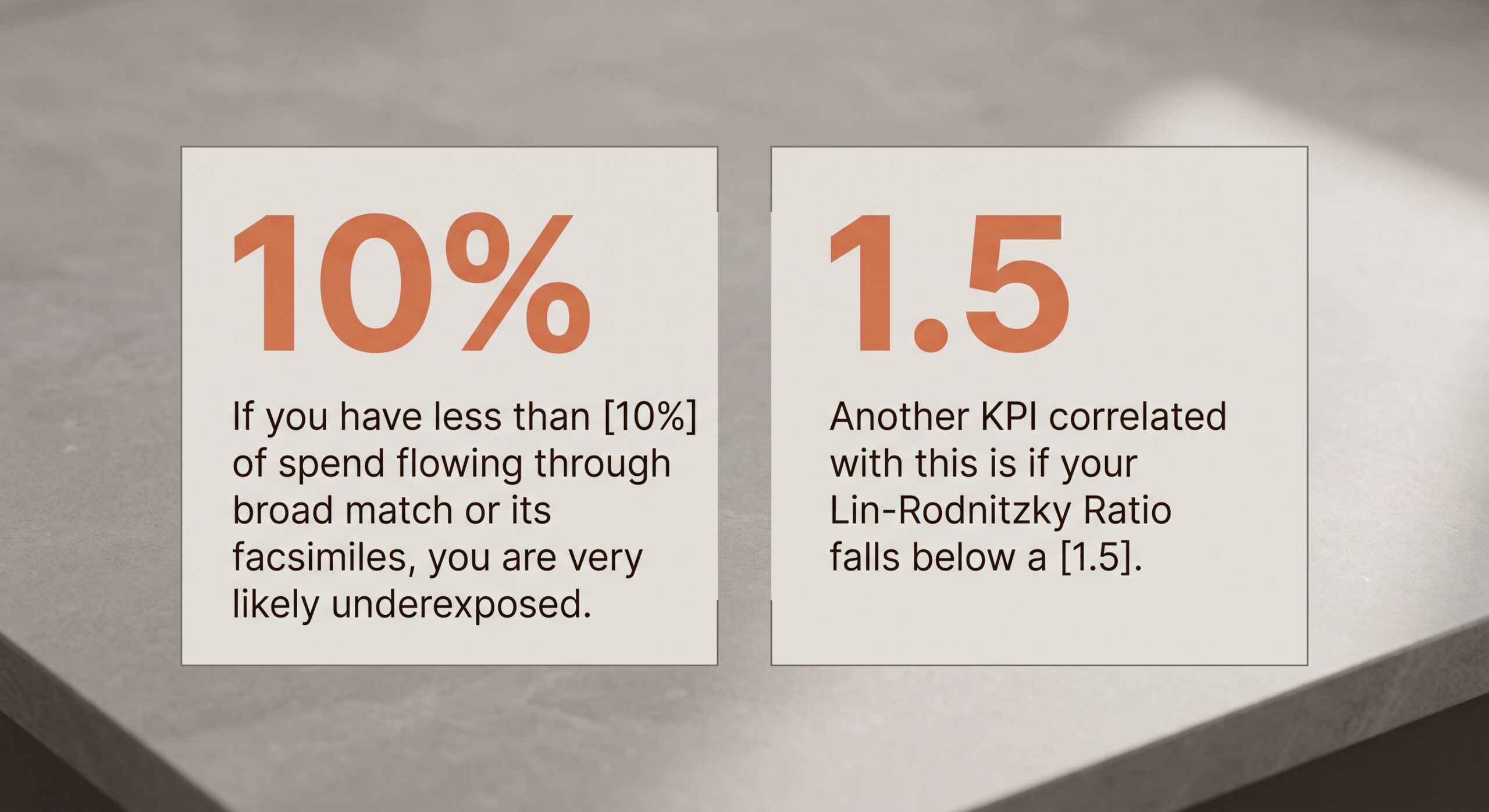
The inverse case is also true. If you have less than 10% of spend flowing through broad match or its facsimiles, you are very likely underexposed. Another KPI correlated with this is if your Lin-Rodnitzky Ratio falls below a 1.5.
We also know that Google is sunsetting dynamic search ads. Some folks have relied on that to act as a sponge, especially mining for unknown queries. The new operating reality has to focus on maximizing your surface area of targeting instead of leaning on this sponge.
You’ll probably work with traditional search campaigns with different layers of targeting, AI Max campaigns, and PMax as well. The key is balancing and calibrating all of these efforts so you don’t waste your spend.

Where This Advice Diverges From Consensus
I’m probably already getting a lot of head shaking from the “Broad Match Bros.” AI-first PPC players, Google reps, and waves of agencies now treat broad match as the obvious play. They figure that smart bidding has gotten good enough to where we can trust the machine and operate in this default setting. All that structural, difficult, unsexy work of building out keywords and ad groups? Who needs it! Keyword targeting? Totally optional.
The pitch is partially correct. Smart bidding has improved. If you’ve got a rigorous, disciplined structure with enough conversion volume, and you set the right bidding strategy with the right budget, you can work wonders. But the hidden assumption that breaks this position is that machine learning alone can carry this performance like some sort of magical carpet ride.
Let me bring you back down to earth. The tells that I’ve seen time and time again when we audit accounts provide the proof. Broad match performs when it has scaffolding. It works well when you’ve excluded everything that needs to be excluded, and when it’s not cannibalized or constrained by budget. It also relies on ads that vary enough to match the variety of queries that come in. If you strip any of these variables, the targeting isn’t going to work as intended, or at least, as well as it could.
You want to move away from the Broad Match Bros? Here’s what you do.

Fight the “Broad Match Bros” With This Approach
Again, broad match needs isolation, liquidity, and calibration. Here’s what to do:
- Put broad match keywords into their own campaign, and probably their own ad group. Don’t commingle them with phrase and exact. That’s a surefire way to have broad match run away with the spend.
- Consider excluding all currently targeted keywords in the account. If there’s a query you already know works, don’t allow it to flow through a broad match where it potentially has a worse ad relevance or landing page experience.
- Consider a bidding strategy that is, at least, initially somewhat aggressive. Be sufficiently competitive in auction to reach new auctions where you previously may have not been present, or until that new broad match campaign can generate enough conversions for a more conservative or efficiency-based bidding strategy or target to function well. What you do will depend on what role this campaign is playing in your overall strategy: Is it a scout or is it a core campaign?
- Have enough budget to deliver significant conversions within a 30-day window at the threshold CPA. If you under-budget the campaign, it will kill any liquidity that makes the strategy work in the first place. If you’re limited by budget, you might miss out on auctions at certain times of the day, certain regions, certain devices, and so on. So try to maximize your liquidity.
- Think about your creative. This may be a scenario where you want a responsive search ad (RSA) that has numerous headlines and numerous descriptions. Have some broad, thematic headlines that offer different appeals, and keep them as relevant as you can to the broad match keywords. Don’t forget, however, that with more headlines and descriptions, you exponentially increase your ad combinations, so balance variation with the consideration that you are looking for a signal and not just random noise.
- Calibrate correctly. I would suggest that you never flow a majority of search or non-search spend through the broad match campaign. You should be regularly mining search terms, excluding what makes sense to exclude, and perform build outs in other campaigns based on new queries you’ve unearthed.
When done right, controlled use of broad match keywords can increase your reach, generate more conversions, and get you a better cost per conversion. Is it time to reduce the risk of unknown unknowns in your pay-per-click efforts?
Where Do You Stand on Broad Match?
Card-carrying Broad Match Bro, hold-out, or somewhere in the middle? Tell me what share of your search spend flows through broad match today, and what happened the first time you isolated it in its own campaign. Every comment gets read, and the best ones shape what I write next.
Prefer to talk it through privately? Request a strategy session.